


When evaluating HVAC air filters, the MERV rating is often one of the first specifications considered. It indicates how efficient a filter is at capturing particles of different sizes and helps determine whether it can support a building’s indoor air quality requirements.
However, two filters with the same initial MERV rating may not provide the same level of performance throughout their service life.
The type of media used inside the filter can affect pressure drop, energy consumption and long-term particle-capture efficiency. Understanding the differences between electrostatic and mechanical media can help facility managers, engineers and building owners select a filter that meets both the needs of the HVAC system and the requirements of the application.
Watch: Electrostatic vs. Mechanical Filters
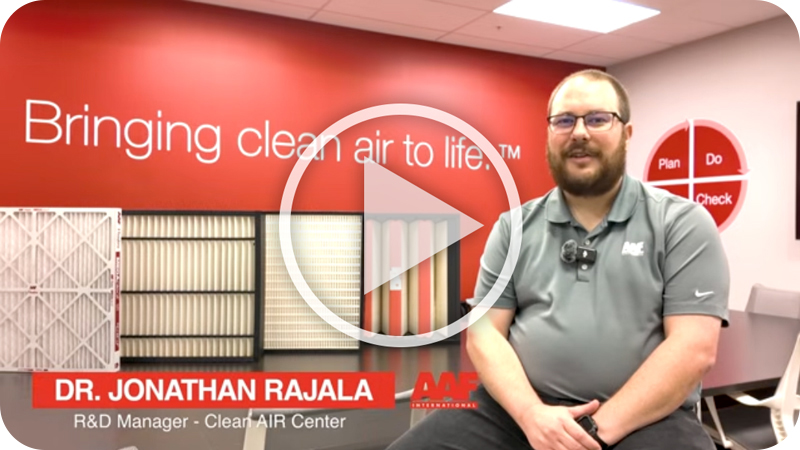
See these differences in action as Jonathan Rajala, R&D Manager at the AAF International Clean AIR Center, explains how mechanical and electrostatic filter media capture particles and how their performance can change over time.
What Is Mechanical Filter Media?
Purely mechanical filter media captures particles as air passes through a network of fibers. Particles are removed from the airstream through physical filtration mechanisms such as interception, impaction and diffusion.
This type of media does not depend on an electrostatic charge to maintain a higher level of efficiency. As a result, mechanical filters generally provide stable and predictable particle-capture performance throughout their service life.
As particulate accumulates within the media, filtration efficiency typically remains consistent or increases. The collected particles contribute to the filter performance and create additional opportunities to capture more contaminants until the filter reaches its recommended changeout point.
The primary tradeoff is resistance to airflow. Increasing the efficiency of mechanical media also increases pressure drop. For example, a mechanical MERV 13 filter will generally create more resistance than a similarly designed mechanical MERV 11 filter.
Higher pressure drop requires the HVAC system fan to use more energy to maintain the desired airflow. This makes it important to select a filter that provides the required efficiency without exceeding the capabilities of the system.
What Is Electrostatic Filter Media?
Electrostatic filter media, also known as electret media, contains fibers that receive an electrostatic charge during manufacturing.
Many airborne particles carry some level of electrical charge. The charged fibers attract these particles and pull them out of the airstream, similar to the way a magnet attracts certain materials.
Because electrostatic attraction supports particle capture, electret media can achieve a higher initial efficiency without relying solely on a dense network of fibers. This can allow an electrostatic charged filter to provide a lower initial pressure drop than a purely mechanical filter with the same MERV rating.
Lower resistance reduces the energy required to move air through the filter. As a result, electrostatic media may provide an initial energy-efficiency advantage, particularly in HVAC systems with limited fan capacity.

How Electrostatic Efficiency Can Change Over Time
The primary limitation of electret media is that its electrostatic charge may weaken or become less effective during use.
Environmental conditions such as heavy particulate loading, high humidity and exposure to exhaust fumes can reduce the media’s ability to capture smaller particles. As the charge dissipates or becomes masked, the filter’s efficiency may decline even though airflow through the filter remains acceptable.
Laboratory testing can demonstrate this effect through accelerated conditioning with fine particulate loading. In one example, the performance of a MERV 13 electrostatic filter gradually declined to the performance level of a MERV 10 filter.
In real-world applications, certain environmental conditions may reduce the efficiency of electret media by the equivalent of two to four MERV ratings. This means a filter selected for its initial rating may not maintain that same level of performance throughout its installed life.
Electrostatic media can still be an effective filtration option. However, its initial MERV rating and pressure drop should not be the only factors considered during filter selection.
How Mechanical Efficiency Changes Over Time
Purely mechanical media does not rely on electrostatic charge, so its efficiency is not affected by charge dissipation.
As particulate accumulates, the filter will generally maintain or increase its particle-capture efficiency. Its pressure drop will also increase as the media loads, which is why mechanical filters should be monitored and replaced when they reach the appropriate final resistance.
Although mechanical media may have a higher initial pressure drop, it provides greater assurance that filtration efficiency will remain stable throughout the filter’s service life.
This predictable performance can be especially important in applications where reduced efficiency could affect indoor air quality, occupant protection, product quality or process control.
Filter design can also help balance consistent mechanical efficiency with airflow requirements. For example, the PerfectPleat® SC M8 uses mechanical filtration media that does not rely on electrostatic charge, while its low-pressure-drop design helps address energy and airflow considerations.

Selecting the Right Media for the Application
Both electrostatic and mechanical filter media offer important advantages. The appropriate choice depends on the HVAC system, operating environment and required level of particulate control.
Electrostatic media may be well suited for residential systems, hotels, light commercial buildings and other applications where available space or fan capacity is limited. Its lower initial resistance can help maintain airflow and reduce initial fan energy requirements.
Mechanical media is generally the stronger choice for healthcare facilities, laboratories, controlled environments, critical manufacturing areas and other applications where filtration efficiency must remain consistent throughout the filter’s service life. Products designed around sustained efficiency, such as the PREpleat® M13, can help address applications where maintaining higher particulate-removal performance over time is a priority.
When comparing the two options, facility managers should consider:
- Required filtration efficiency
- Available fan capacity
- Acceptable system pressure drop
- Environmental conditions
- Expected particulate loading
- Filter replacement practices
- The consequences of reduced efficiency
For applications where minimizing resistance is the primary concern, electrostatic media may provide an effective solution. For environments where consistent particulate control is essential, mechanical media may be the more appropriate choice.
Understanding how each media type captures particles and performs over time can help ensure the selected filter supports indoor air quality objectives without placing unnecessary demands on the HVAC system.
Originally published by AAF International. Reproduced with permission. Read the original article.
Filters Unlimited Can Help
At Filters Unlimited, we supply a wide range of commercial HVAC filtration solutions, including AAF and other high-performance filtration products.
If you’re evaluating options for replacing traditional box filters or improving your facility’s filtration strategy, our team can help you choose the right solution for your system.
Contact Filters Unlimited today to discuss filtration options for your facility. Call today: (302) 455-0551